
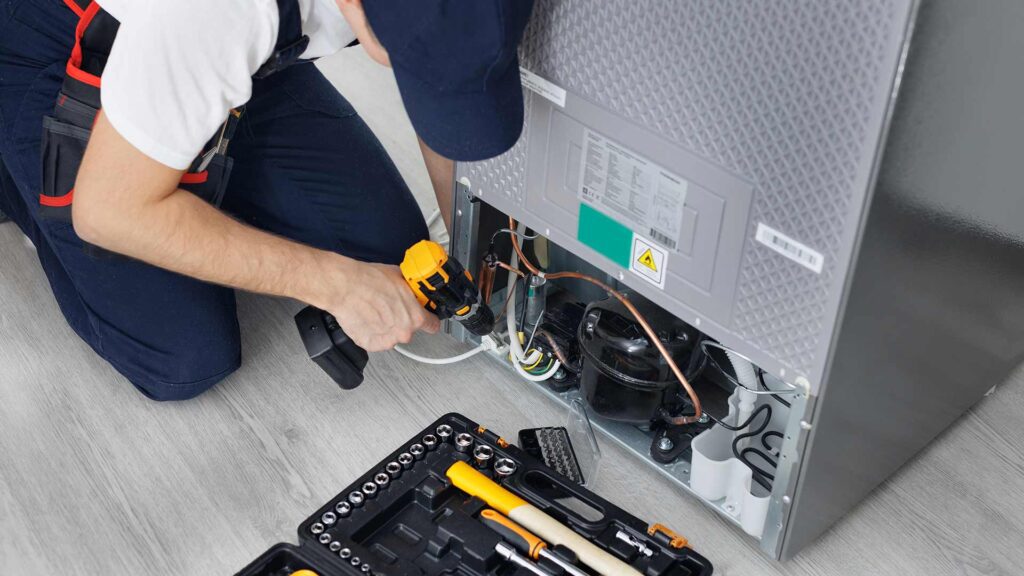
When an Ontario heat wave rolls in, your refrigerator is the hardest-working appliance in the house — and often the first to struggle. Warmer kitchens, higher humidity, and constant door-opening all force the compressor to run longer just to hold temperature. If your fridge is not cooling in summer, a warm compartment can turn a full grocery haul into spoiled food in a matter of hours.
Here’s what’s really going on when the heat climbs, the checks you can safely do yourself, and the warning signs that mean it’s time to call a technician.
Why summer is so hard on your refrigerator
A fridge doesn’t make cold — it moves heat out of the cabinet and dumps it into your kitchen. The hotter the room, the harder that job becomes. On a 30°C day, a refrigerator can run almost continuously to stay at 4°C inside. That extra runtime exposes any weak part — a tired compressor, a marginal fan, or a coil caked in dust — that coasted through the cooler months. It’s the number-one reason we see a spike in refrigerator repair calls across Barrie, Simcoe County, and the GTA every July and August.
7 reasons your fridge isn’t cooling in the heat
- Dirty condenser coils. The coils (behind or beneath the fridge) release heat. When they’re coated in dust and pet hair, they can’t shed heat efficiently, and in a hot room the fridge simply can’t keep up. This is the single most common summer cause — and the easiest to prevent.
- Poor ventilation. A fridge pushed tight against the wall or boxed into a cabinet has nowhere to release heat. It needs a few centimetres of clearance on the sides, back, and top to breathe.
- A garage or hot-room fridge. Many households keep a second fridge or freezer in the garage. Most standard units are only rated to work in ambient temperatures up to about 32–38°C. Once the garage gets hotter than that, the appliance can’t cycle properly and stops holding temperature.
- A worn door gasket. The rubber seal keeps warm, humid summer air out. If it’s cracked, stiff, or no longer grabbing the door, cold air leaks and the compressor runs non-stop. Test it by closing the door on a slip of paper — if it pulls out easily, the seal is weak.
- Overpacking and blocked vents. Stocking up for a long weekend feels smart, but crammed shelves block the internal air vents that circulate cold air. Food near the vents freezes while the rest of the compartment goes warm.
- A failing condenser or evaporator fan. These fans move air across the coils and through the cabinet. When a fan motor wears out — often announced by a buzzing or grinding noise — cooling drops fast, especially under summer load.
- Compressor, start relay, or a sealed-system leak. If the fridge is silent, warm, and the coils are clean, the problem may be the compressor, its start relay, or a refrigerant leak in the sealed system. These are not DIY repairs — they require certified tools and, for sealed systems, a licensed technician.
Safe checks you can do yourself first
- Clean the condenser coils. Unplug the fridge, find the coils (behind the kick plate or on the back), and vacuum off the dust. Do this twice a year — it’s the best thing you can do for summer performance.
- Give it room to breathe. Pull the unit a few centimetres off the wall and make sure nothing is blocking the vents on top or underneath.
- Check the thermostat setting. Aim for 3–4°C in the fridge and −18°C in the freezer. A knocked dial is a surprisingly common “repair.”
- Inspect the door seal. Wipe it clean and run the paper test. A dirty gasket often just needs a wipe-down to seal again.
- Don’t overload it. Leave space around the internal vents so cold air can circulate.
Warning signs it’s time to call a technician
If you’ve done the checks above and the fridge still isn’t cooling, don’t wait — every hour of a warm fridge is money on your grocery bill.
Call a technician right away if you notice:
- The compartment stays above 5°C even on the coldest setting
- The fridge is silent (no gentle hum) or unusually loud, buzzing, or clicking
- Frost building up on the back wall or freezer floor
- Water pooling under or inside the unit
- An error code on the display — for example LG’s Er FF or Er CO, Samsung’s 22 E or 5 E, or a flashing temperature light on Whirlpool and GE models
Our TSSA-certified technicians service every major brand — LG, Samsung, Whirlpool, Bosch, GE, Frigidaire, Kenmore, KitchenAid, and Maytag. See the full list on our brands we repair page.
Don’t risk your groceries — same-day fridge repair when you need it
A refrigerator that fails in a heat wave is a genuine emergency. At Appfix we offer same-day emergency appliance repair so you’re not left watching your food spoil. Our technicians arrive fully stocked, diagnose the fault on the spot, and most repairs are finished in a single visit. We serve Barrie, Orillia, and communities right across Central Ontario and the GTA — see all areas we serve.
Fridge warm and climbing?
Book same-day fridge repair before your food spoils
- ★ 5.0 · 223 Google reviews
- TSSA-certified technicians
- $35 off your first repair
- No fix — no fee